

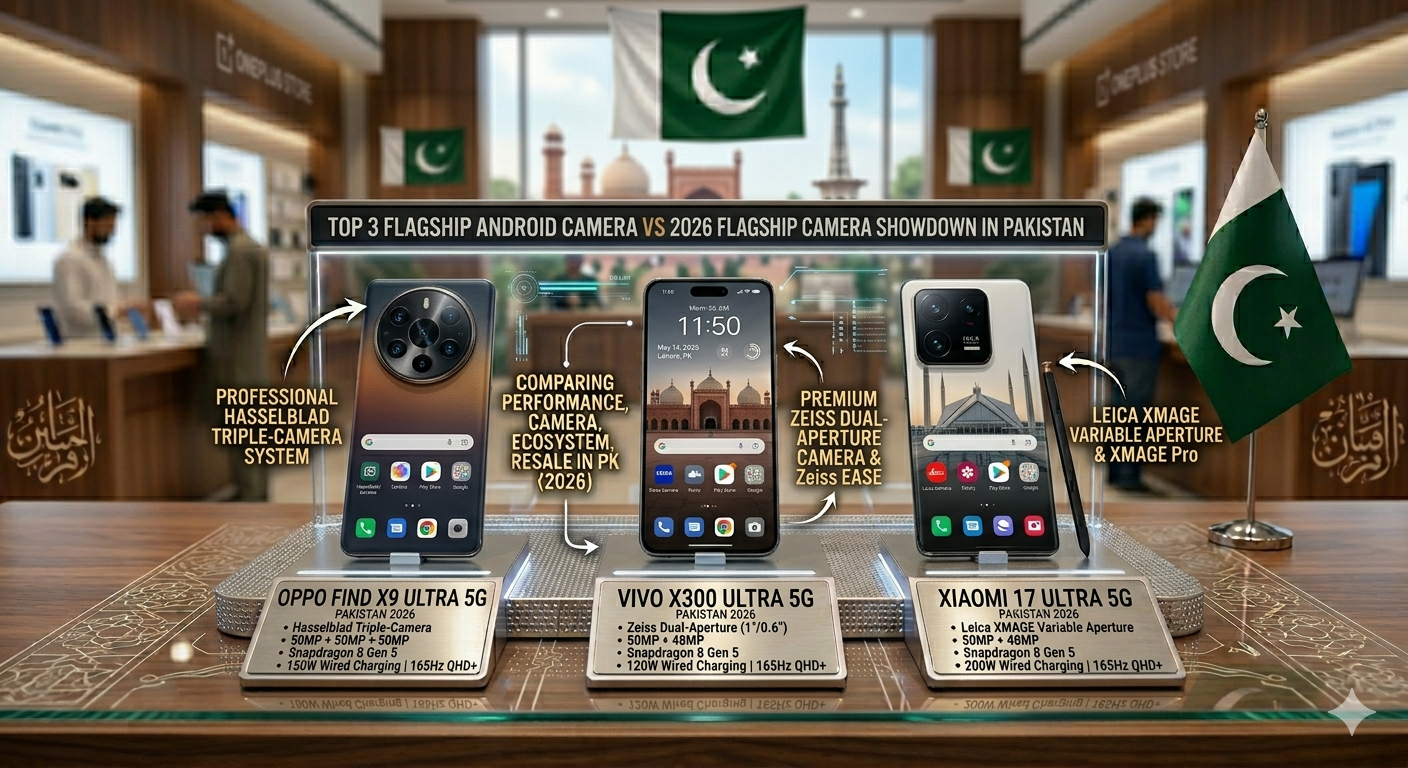
Top 3 Flagship Android Camera Phones in Pakistan 2026 — Oppo, Vivo and Xiaomi Compared
Camera technology in Android flagships has reached a point in 2026 where the gap between the top three contenders and everything below them is genuinely significant — not incremental. Oppo Find X9 Ultra, Vivo X300 Ultra, and Xiaomi 17 Ultra represent three completely different philosophies on what a camera phone should prioritize, how computational photography should work, and what hardware is worth engineering at this price tier.
This comparison covers only what matters for camera-focused buyers — imaging hardware, display quality for reviewing shots, chipset processing power for computational photography, and charging speed for keeping the phone alive through extended shooting sessions. Everything else is noise.
1. Oppo Find X9 Ultra — Hasselblad Precision at the Top of the List
Why it ranks first: The Find X9 Ultra is the most technically refined camera package of the three. Hasselblad Color Calibration — a genuine hardware and software collaboration, not a marketing badge — produces colour science that stands apart from every other Android camera system in Pakistan’s market right now. The combination of a large primary sensor, 200MP periscope telephoto, and Hasselblad’s LUT preview system gives this phone a professional photography workflow that the other two do not replicate.
Camera Hardware:
Primary: 50MP f/1.5, 23mm wide, 1/1.28-inch sensor, 1.22µm pixel size, multi-directional PDAF with OIS. The f/1.5 aperture is the widest main lens of the three phones — more light gathering in low light conditions than either Vivo or Xiaomi’s primary sensors. The 1/1.28-inch sensor size is large enough to produce genuine shallow depth of field at close distances and captures detail in challenging light that smaller sensors miss entirely.
Periscope Telephoto: 200MP f/2.1, 70mm equivalent, 1/1.56-inch sensor, 3x optical zoom, multi-directional PDAF with OIS. A 200MP telephoto sensor is the headline specification here — the ability to crop digitally from a 200MP base while maintaining detail is a genuine computational photography advantage over a standard telephoto. Zoom photography on Find X9 Ultra at 3x optical and beyond produces images with detail retention that the 50MP telephoto sensors in competitors cannot match when cropped equivalently.
Ultrawide: 50MP f/2.0, 15mm, 120-degree field of view, 1/2.76-inch sensor, multi-directional PDAF. The ultrawide includes PDAF — autofocus capability across the full ultrawide frame — which most ultrawide cameras lack entirely. Architecture photography, interior shots, and close-distance ultrawide subjects all benefit from this.
Additional camera features: Laser AF, color spectrum sensor for accurate white balance under mixed artificial lighting, Hasselblad LUT preview for professional colour grading in-camera, HDR, panorama. 4K recording at 30/60/120fps, 10-bit video, Dolby Vision, LOG format for post-production colour grading. Gyro-EIS stabilization across all video modes.
Front Camera: 50MP f/2.0, 21mm wide, 1/2.76-inch sensor, PDAF. 4K video front camera with gyro-EIS.
Display for Photography Review: 6.78-inch LTPO AMOLED. 450 PPI. 120Hz adaptive. 3,600 nit peak brightness — the highest measured peak of the three phones in this comparison. 2,160Hz PWM dimming for flicker-free display at all brightness levels. Dolby Vision and HDR10+ for accurate colour representation when reviewing images and video. 1,175 nits measured real-world maximum brightness. Corning Gorilla Glass Victus 2. Ultra HDR image support — images shot in Ultra HDR display with the full dynamic range the sensor captured rather than a compressed version.
Chipset for Computational Photography: MediaTek Dimensity 9500 at 3nm. AnTuTu v11 score of 3,563,384. GeekBench v6 single-core 9,697. The Dimensity 9500’s AI processing pipeline handles Hasselblad’s computational photography algorithms in real time — night mode processing, subject separation for portrait mode, and the LUT colour preview system all depend on the NPU performance this chip delivers. 3DMark Wild Life Extreme 6,808.
Charging: 7,500mAh Si/C battery — the largest battery of the three by a meaningful margin. 80W wired charging, 50W wireless charging, 10W reverse wireless. Active use score of 21 hours 57 minutes in testing — the longest endurance of the three phones. For photographers shooting all day in the field this battery capacity combined with 80W charging means a 30-minute charge during a break restores most of what a full shoot consumes.
For original Oppo 80W SUPERVOOC charging accessories — essential for maintaining correct charging speed on Find X9 Ultra — Oppo Store Pakistan carries verified genuine accessories including the Oppo 80W SUPERVOOC Charger with original certification.
Build: 161.3 x 76.5 x 8.3mm. 224g. Gorilla Glass Victus 2 front and back. Aluminum frame. IP68 and IP69 dual water resistance — the same dual rating as Huawei Mate 80 Pro Max, adding protection against high-pressure water jets beyond standard IP68 immersion coverage. Available in Silk White, Titanium Charcoal, Velvet Red.
2. Vivo X300 Ultra — Zeiss Optics and the Most Versatile Zoom System
Why it ranks second: Vivo X300 Ultra brings the most ambitious zoom system of the three — two 200MP sensors covering different focal lengths, optional add-on Zeiss lenses extending reach to 200mm and 400mm, and 8K video recording. The Snapdragon 8 Elite Gen 5 chipset delivers the highest benchmark scores of the three phones. What keeps it second rather than first is the battery endurance — 15 hours 45 minutes active use score versus Oppo’s 21 hours 57 minutes is a meaningful difference for full-day shooting sessions.
Camera Hardware:
Primary: 200MP f/1.9, 35mm wide equivalent, 1/1.12-inch sensor — the largest primary sensor of the three phones. 0.7µm pixel size. PDAF with gimbal OIS. The gimbal OIS system — a mechanical stabilization mechanism that moves the entire sensor module rather than just the lens elements — produces video stabilization that optical OIS systems cannot fully replicate. Walking shots, handheld low light video, and long exposure photography all benefit from gimbal stabilization in ways that show clearly in the output.
The 200MP primary sensor on a 1/1.12-inch sensor is the standout hardware specification of this entire comparison. Pixel binning in standard shooting combines multiple pixels for improved noise performance. At full 200MP resolution in good light the detail capture is extraordinary.
Periscope Telephoto: 200MP f/2.7, 85mm equivalent, 1/1.4-inch sensor, 3.7x optical zoom, multi-directional PDAF with OIS. A second 200MP sensor at a longer focal length — both primary and telephoto operating at 200MP is unique to Vivo X300 Ultra. Portrait photography at 85mm with a 200MP sensor produces images with subject separation and detail that 50MP telephoto sensors at comparable focal lengths cannot match.
Ultrawide: 50MP f/2.0, 14mm, 116-degree field of view, 1/1.28-inch sensor — the largest ultrawide sensor of the three phones. Dual pixel PDAF with OIS on the ultrawide is rare hardware. The combination of a large ultrawide sensor with OIS means ultrawide shots in low light and video on the ultrawide lens are both stronger than competitors’ ultrawide implementations.
Optional Zeiss add-on lenses: 200mm at 2.35x optical zoom with OIS and Zeiss optics. 400mm at 4.7x optical zoom with OIS and Zeiss optics. These are physical lens attachments that clip onto the phone — extending reach beyond what any internal periscope telephoto can achieve. Wildlife photography, sports, and distant subject photography at 400mm optical zoom is a capability no other phone in this comparison offers.
Additional camera features: Zeiss T* lens coating across all cameras for reduced flare and ghosting under challenging light. Laser AF, color spectrum sensor, 3D LUT import for professional colour grading. 8K video at 30fps — the only phone in this comparison with 8K capability. 4K at 24/30/60/120fps in 10-bit Log and Dolby Vision HDR. Hi-Res audio recording at 24-bit/192kHz.
Front Camera: 50MP f/2.5, 24mm wide, 1/2.76-inch sensor, AF. 4K front video with gyro-EIS.
Display for Photography Review: 6.82-inch LTPO AMOLED. 510 PPI — the highest pixel density of the three phones. 144Hz adaptive. 2,160Hz PWM dimming. Dolby Vision and HDR10+. 1,935 nits measured real-world maximum brightness — the highest measured brightness of the three in real-world testing despite Oppo’s higher peak specification. Ultra HDR image support. DisplayPort output through USB-C for connecting to external monitors — useful for reviewing camera output on a larger screen. Armor glass protection.
Chipset for Computational Photography: Qualcomm Snapdragon 8 Elite Gen 5 at 3nm. AnTuTu v11 score of 4,085,695 — the highest benchmark score of the three phones by a significant margin. GeekBench v6 11,494. 3DMark Wild Life Extreme 7,075. The Snapdragon 8 Elite Gen 5’s AI processing handles dual 200MP sensor computational photography, Zeiss lens computational correction, and 8K video encoding simultaneously without performance compromise.
Charging: 6,600mAh Si/C battery. 100W wired charging — the fastest of the three phones. 40W wireless. Reverse wired and reverse wireless charging. Active use score of 15 hours 45 minutes — the shortest endurance of the three despite a large battery, reflecting the power demands of the high-resolution dual sensor system and large display. 100W charging compensates for shorter endurance — a fast top-up restores meaningful battery in minutes.
For Vivo devices and genuine accessories in Pakistan, Vivo Store Pakistan carries verified original Vivo products with proper documentation.
Build: 163 x 76.8 x 8.2mm or 8.5mm depending on variant. 232g or 237g. Glass front and back with aluminum frame. IP68 and IP69 dual water resistance. USB-C 3.2 with DisplayPort output. Available in Black, Silver, Green.
3. Xiaomi 17 Ultra — Leica Engineering and the Most Innovative Telephoto
Why it ranks third: Xiaomi 17 Ultra’s Leica collaboration produces camera output with a colour signature and optical quality that is genuinely distinctive — Leica lenses, not just Leica software processing. The continuously variable optical zoom telephoto — moving between 3.2x and 4.3x optical zoom rather than fixed focal lengths — is a mechanical camera innovation no other smartphone has implemented. What places it third rather than higher is measured display brightness below both competitors and the shortest peak brightness in real-world testing.
Camera Hardware:
Primary: 50MP f/1.7, 23mm wide, 1.0-inch type sensor — the largest sensor of the three primary cameras by sensor format. 1.6µm pixel size. Dual pixel PDAF with OIS. Leica lenses. A 1-inch type sensor at the primary camera is the largest format available in any current smartphone primary camera. Light gathering capability, dynamic range, and low light performance all benefit from sensor size in ways that processing cannot fully compensate for. The Leica optical engineering on this sensor produces colour rendering and contrast that distinguishes Xiaomi 17 Ultra output from other large sensor implementations.
Variable Zoom Telephoto: 200MP f/2.4-3.0, 75-100mm equivalent, 1/1.4-inch sensor, continuous optical zoom between 3.2x and 4.3x, multi-directional PDAF, OIS, zoom ring. This is the most mechanically innovative camera component in this comparison. Conventional smartphone telephoto cameras are fixed focal length — you get 3x optical or 5x optical, nothing between. Xiaomi 17 Ultra’s periscope telephoto moves physically between 75mm and 100mm equivalent focal lengths, giving continuous optical zoom across that range. The physical zoom ring on the phone body controls this movement — the closest any smartphone has come to replicating a traditional camera zoom control. No other phone in this comparison offers this.
At 200MP resolution on a 1/1.4-inch sensor this telephoto also delivers exceptional detail at its maximum optical zoom position for portrait and mid-distance photography.
Ultrawide: 50MP f/2.2, 14mm, 115-degree field of view, 1/2.76-inch sensor, dual pixel PDAF. TOF 3D depth sensor as a fourth camera element for precise subject separation in portrait mode.
Additional camera features: Leica lenses across all cameras with Leica optical corrections applied. Laser AF, color spectrum sensor, dual-LED flash, HDR, panorama. 8K video at 30fps. 4K at 30/60/120fps with 10-bit Dolby Vision HDR recording at 4K60. 1080p at up to 1,920fps for ultra slow motion. 24-bit/192kHz Hi-Res audio recording. Gyro-EIS across all video modes.
Front Camera: 50MP f/2.2, 21mm wide, 1/2.7-inch sensor, AF. 4K front video at 30/60fps with gyro-EIS.
Display for Photography Review: 6.9-inch LTPO AMOLED. 416 PPI — the lowest pixel density of the three. 120Hz adaptive. 3,500 nit peak specification. 2,160Hz PWM dimming. Dolby Vision and HDR10+. 1,132 nits measured real-world maximum brightness — the lowest measured brightness of the three phones in real-world testing. Xiaomi Shield Glass 3.0. Ultra HDR image support. DisplayPort output through USB-C 3.2 Gen 2. 68 billion colors versus 1 billion on the other two — wider colour gradation for image review.
Chipset for Computational Photography: Qualcomm Snapdragon 8 Elite Gen 5 at 3nm — same chipset as Vivo X300 Ultra. AnTuTu v11 score 3,863,387. GeekBench v6 10,896. 3DMark Wild Life Extreme 6,948. The Snapdragon 8 Elite Gen 5 handles Leica computational corrections, variable zoom telephoto processing, and 8K encoding. USB-C 3.2 Gen 2 — the fastest USB implementation of the three for transferring large 200MP RAW files and 8K video to external storage.
Charging: 6,000mAh Si/C battery. 90W wired charging. 50W wireless. 22.5W reverse wired. 10W reverse wireless. Active use score of 19 hours 9 minutes — second best endurance of the three, between Oppo’s 21 hours and Vivo’s 15 hours. IP68 and IP69 dual water resistance with immersion depth rated to 6 metres — deeper water resistance than both competitors which are rated to 1.5 metres. Aerospace-grade glass fiber reinforcement in the build.
For genuine Xiaomi accessories including original 90W charging hardware, Xiaomi Store Pakistan carries verified original Xiaomi products. Their Xiaomi chargers section covers the HyperCharge 90W adapter and compatible cables — essential for maintaining correct charging speed on Xiaomi 17 Ultra.
Build: 162.9 x 77.6 x 8.3mm. 218.4g or 223.4g — the lightest phone of the three. Glass front with glass-fiber reinforced plastic back or eco leather back depending on variant. Aluminum frame. IP68/IP69 with 6-metre depth rating. Available in Black, White, Starlit Green.
Camera System Comparison — All Three at a Glance
| Camera Element | Oppo Find X9 Ultra | Vivo X300 Ultra | Xiaomi 17 Ultra |
|---|---|---|---|
| Primary Sensor | 50MP 1/1.28″ f/1.5 | 200MP 1/1.12″ f/1.9 | 50MP 1.0-type f/1.7 |
| Primary OIS | Standard OIS | Gimbal OIS | Standard OIS |
| Telephoto | 200MP 3x f/2.1 | 200MP 3.7x f/2.7 | 200MP 3.2-4.3x variable |
| Ultrawide | 50MP 120° f/2.0 | 50MP 116° 1/1.28″ OIS | 50MP 115° f/2.2 |
| Camera Brand | Hasselblad | Zeiss | Leica |
| Max Video | 4K 120fps | 8K 30fps | 8K 30fps |
| Video Format | 10-bit Dolby Vision | 10-bit Log Dolby Vision | 10-bit Dolby Vision |
| Front Camera | 50MP f/2.0 PDAF | 50MP f/2.5 AF | 50MP f/2.2 AF |
Display Comparison
| Display Spec | Oppo Find X9 Ultra | Vivo X300 Ultra | Xiaomi 17 Ultra |
|---|---|---|---|
| Size | 6.78 inches | 6.82 inches | 6.9 inches |
| Resolution PPI | 450 PPI | 510 PPI | 416 PPI |
| Refresh Rate | 120Hz LTPO | 144Hz LTPO | 120Hz LTPO |
| Peak Brightness | 3,600 nits | — | 3,500 nits |
| Measured Brightness | 1,175 nits | 1,935 nits | 1,132 nits |
| PWM Dimming | 2,160Hz | 2,160Hz | 2,160Hz |
| Protection | Gorilla Glass Victus 2 | Armor Glass | Xiaomi Shield Glass 3.0 |
| DisplayPort | No | Yes | Yes |
Battery and Charging Comparison
| Charging Spec | Oppo Find X9 Ultra | Vivo X300 Ultra | Xiaomi 17 Ultra |
|---|---|---|---|
| Battery Capacity | 7,500mAh | 6,600mAh | 6,000mAh |
| Wired Charging | 80W | 100W | 90W |
| Wireless Charging | 50W | 40W | 50W |
| Reverse Wireless | 10W | Yes | 10W |
| Active Use Score | 21h 57m | 15h 45m | 19h 9m |
Category Winners
| Category | Winner | Reason |
|---|---|---|
| Primary Sensor Size | 🏆 Xiaomi 17 Ultra | 1.0-inch type — largest primary sensor |
| Primary Aperture | 🏆 Oppo Find X9 Ultra | f/1.5 — widest main lens |
| Gimbal Stabilization | 🏆 Vivo X300 Ultra | Only gimbal OIS primary camera |
| Telephoto Innovation | 🏆 Xiaomi 17 Ultra | Variable continuous optical zoom |
| Ultrawide Sensor | 🏆 Vivo X300 Ultra | 1/1.28″ ultrawide with OIS |
| Camera Brand | 🏆 Subjective | Hasselblad / Zeiss / Leica — all genuine |
| Max Resolution | 🏆 Vivo X300 Ultra | Dual 200MP sensors |
| Video Maximum | 🏆 Vivo / Xiaomi | Both shoot 8K |
| Colour Science | 🏆 Oppo Find X9 Ultra | Hasselblad calibration most refined |
| Display Pixel Density | 🏆 Vivo X300 Ultra | 510 PPI — sharpest display |
| Display Brightness Measured | 🏆 Vivo X300 Ultra | 1,935 nits real-world |
| Battery Endurance | 🏆 Oppo Find X9 Ultra | 21h 57m active use |
| Charging Speed | 🏆 Vivo X300 Ultra | 100W wired |
| Battery Capacity | 🏆 Oppo Find X9 Ultra | 7,500mAh |
| Water Resistance Depth | 🏆 Xiaomi 17 Ultra | IP68/69 to 6 metres |
| Weight | 🏆 Xiaomi 17 Ultra | 218.4g — lightest of three |
| Chipset Performance | 🏆 Vivo X300 Ultra | Highest AnTuTu and GeekBench scores |
| Overall Camera Package | 🏆 Oppo Find X9 Ultra | Hasselblad system most complete |
Which Should You Buy
Buy Oppo Find X9 Ultra if camera colour science and all-day battery endurance are your priorities. Hasselblad’s LUT preview and calibration system produces the most professional photography workflow of the three. The 7,500mAh battery with 21-hour active use endurance means a full day of intensive shooting without anxiety. IP68 and IP69 dual water resistance adds confidence for outdoor shooting in challenging conditions.
Buy Vivo X300 Ultra if maximum resolution, zoom versatility, and the highest benchmark performance matter most. Dual 200MP sensors, optional Zeiss add-on lenses extending to 400mm optical zoom, 8K video, and the brightest measured display of the three make it the most specification-heavy option. 100W charging compensates for shorter battery endurance.
Buy Xiaomi 17 Ultra if the primary sensor quality and the variable zoom telephoto innovation are compelling to you. The 1-inch type Leica primary sensor produces the best single-frame image quality of the three in good light. The continuously variable optical zoom telephoto is a mechanical innovation that no other smartphone currently offers. Lightest of the three and deepest water resistance rating.
All three phones are available to import into Pakistan. Genuine original accessories for each brand are available through verified Pakistani online stores — original chargers for fast charging protocols, genuine cables, and brand accessories that maintain correct hardware communication for these high-wattage charging systems.